
Digital Marketing Without Guesswork: How Data Drives Better Decisions
Introduction
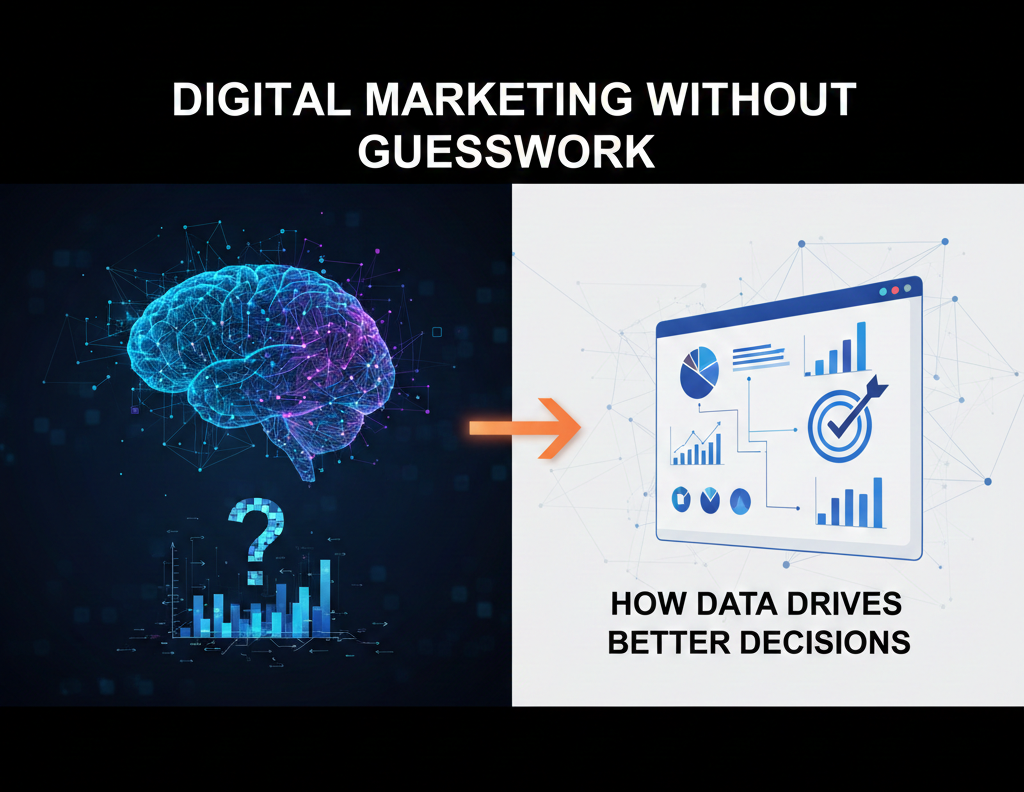
Data-Driven Digital Marketing has completely changed how businesses approach growth in today’s competitive environment. Unlike traditional marketing, which relied heavily on intuition, assumptions, and past experience, data-driven marketing focuses on facts, measurable insights, and real-time performance tracking. Companies no longer need to guess what might work—they can track user behaviour, analyse engagement patterns, optimise campaigns, and make informed decisions backed by data.
In the digital era, every click, scroll, and interaction leaves a footprint. Businesses can now measure website traffic, monitor social media engagement, track ad performance, and evaluate customer journeys with precision. This level of transparency allows marketers to identify strengths, detect weaknesses, and continuously refine their strategies for better outcomes.
With a strong digital marketing strategy, businesses can clearly understand what attracts their audience, what content performs best, and which channels drive meaningful conversions. Instead of investing blindly across multiple platforms, companies can focus their efforts where results are proven. Marketing analytics ensures every decision is based on evidence, reducing wasted budget, improving efficiency, and maximising ROI in marketing.
Moreover, data helps businesses respond quickly to market changes. If a campaign underperforms, adjustments can be made immediately. If a strategy succeeds, it can be scaled for greater impact. This flexibility gives businesses a competitive advantage in fast-moving markets.
This blog explores how data-driven digital marketing eliminates guesswork, strengthens strategic planning, and empowers businesses to achieve consistent, measurable, and sustainable success in the digital landscape.
Why Guesswork Fails in Marketing
Relying on assumptions can be costly. Without marketing analytics, businesses cannot clearly see which campaigns drive traffic, conversions, or revenue.
Common problems include:
Spending money on low-performing channels
Losing potential customers due to poor targeting
Not knowing which content or ads resonate with the audience
Guesswork leads to wasted budgets and missed opportunities. Data-driven digital marketing replaces uncertainty with actionable insights, giving businesses a competitive edge.
How Data Improves Digital Marketing
1. Understanding Customer Behaviour
Tools like Google Analytics and social media insights allow marketers to track how users interact with websites and content. Businesses can see:
Which pages users visit
How long they stay
Where they drop off
What devices they use
This information helps identify what attracts attention and what needs improvement. Instead of assuming what customers want, businesses can respond to real behaviour patterns.
2. Improving Campaign Performance
Data helps marketers identify high-performing campaigns and eliminate weak ones. By analysing metrics such as click-through rate (CTR), cost per click (CPC), and conversion rate, businesses can optimise their advertisements.
For example, if one ad creative performs better than another, marketers can allocate more budget toward the stronger version. This continuous testing process, often called A/B testing, ensures consistent improvement.
3. Personalising User Experience
Consumers expect relevant content. By using data-driven digital marketing, businesses can deliver personalised offers, product recommendations, and content tailored to individual preferences.
Personalisation improves engagement, drives conversions, and enhances customer satisfaction, turning one-time buyers into loyal clients.
4. Better Budget Allocation
One of the biggest advantages of data-driven marketing is financial control. Businesses can clearly see which channels generate returns.
Instead of spending equally across all platforms, marketers can invest more in high-performing campaigns and reduce spending on underperforming ones. This improves return on investment (ROI) and prevents unnecessary losses.
Key Metrics That Matter
Rather than focusing on vanity metrics like likes or shares, data-driven digital marketing tracks metrics that directly impact business growth:
Traffic quality
Conversion rate
Cost per lead (CPL)
Customer retention rate
ROI in marketing
By monitoring these metrics, businesses make informed decisions and continually improve their marketing efforts.
Why Data-Driven Marketing Is the Future
In an increasingly competitive landscape, businesses that embrace data-driven digital marketing gain a significant advantage. Data enables faster decision-making, precise targeting, and continuous improvement.
Rather than guessing, marketers can test strategies, analyse results, and scale what works. Companies ignoring marketing analytics risk falling behind competitors who make data-backed decisions.
Conclusion
Data-driven digital marketing transforms marketing from a guessing game into a predictable growth system. By leveraging marketing analytics, businesses can understand customer behaviour, optimise campaign performance, allocate budgets wisely, and boost ROI in marketing.
In today’s digital world, relying on intuition alone is no longer enough. Success belongs to businesses that make decisions based on insights, not assumptions. Data is the key to smarter marketing, higher engagement, and long-term growth.